

SEARCH RESULTS Spring Summer Autumn Winter Goto Islands Search Criteria: 28 Hits 1 - 12
-
 1
1
Goto Camellia Festival
Goto is well-known as a natural habitat for camellias, and the people of the islands have a long history of integrating this flower into their lives. The Goto Camellia Festival allows visitors to experience winter on the islands with the camellia in full bloom. Food vendors and souvenir shops will be available at the Goto Umakamon-Ichi Market during the opening of the festival. Viewing tours venturing into the natural camellia forests will be held as well. -
 2
2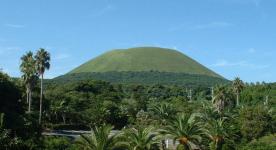
Mt. Onidake
Mt. Onidake, a symbol of Goto, is a 315-meter cinder-cone volcano, which last erupted an estimated 18000 years ago. The volcano, which is covered in grass, is well-known as a venue for an annual kite-flying event, and as a leisure spot -
3
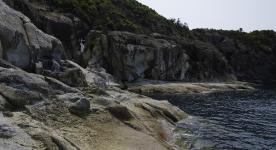
Christian’s Cave and the ‘Eye of the Needle’
It is said that during the repression of Christianity during the Meiji Era, believers lived in hiding in this cave. A 4-meter tall cross and a 3.6-meter statue of Jesus were built in 1967. Even now the cave is only accessible by boat. -
4
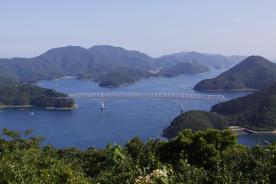
Wakamatsu Bridge
The white truss bridge which joins Shinkamigoto’s Nakadori Island and Wakamatsu Island interweaves with the blue ocean, azure sky and the green mountains to create a splendid view over the Wakamatsu Strait. A popular viewing spot for this bridge is Mt. Ryukan (Ryukansan). You can also get a closer look at the nearby shore below the bridge. -
5
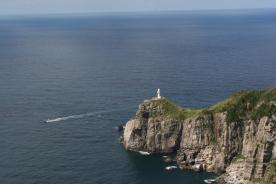
Osezaki Lighthouse
This white lighthouse is located at Osezaki Cliff, which was formed by erosion from the wild waves of the East China Sea. The combination of the lighthouse, the cliff and the surrounding natural environment presents a spectacular view. -
6
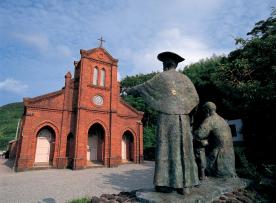
Dozaki Church
This is the oldest church in the Goto islands, and it was built by French missionaries. It now serves a museum displaying historical documents relating to Christians and the 300-year period of suppression of Christianity. It was designated as a Tangible Cultural Asset of Nagasaki Prefecture in 1974. -
7
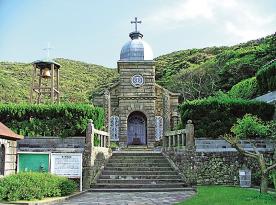
Kashiragashima Church
Kashiragashima ChurchThis sandstone church, a rare sight in Japan, was built by Christians returning to the islands after the period of persecution, from stones they quarried themselves. The church is designated as an Important Cultural Property of Japan and is part of the “Churches and Christian Sites in Nagasaki” bid for designation as a World Heritage Site. -
8
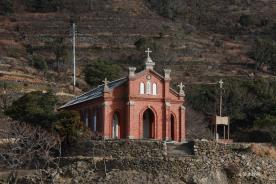
Former Nokubi Church
In the Nozaki Island, located in the north of the Goto Islands, there used to be two Christian communities, called "Nokubi" and "Setozaki." In spite of the poverty due to the mountainous area and infertile soil, both communities built wooden churches. Eventually, 18 Christian families began constructing a brick church. Through their endeavors and enthusiasm, Nokubi Church was completed. It was designed and constructed by Yosuke Tetsukawa, and it was the first brick church for him. However, after Japan entered the period of rapid economic growth, more and more people left the island. By 1971, all the residents had gone out of Nozaki Island. On the now uninhabited island, Nokubi Church soon deteriorated. However, the church was restored and repaired by the government of Ojika Town, in which the church is located. -
9

Imochiura Church and Lourdes
This church was constructed under the direction of French missionary Father Peroud. Located near the church is the first Lourdes grotto in Japan, which was built in response to Father Peroud’s exhortation, and modeled after the Massabielle Grotto in Lourdes in the south of France. -
10
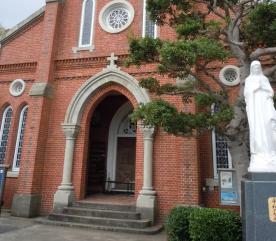
Aosagaura Church
The Aosagaura area was settled by Christians from Sotome, who battled harsh living conditions and severe oppression until the ban on Christianity was lifted in 1873. In 1878, they were finally able to build their church, taking charge of missionary work in the whole upper-Goto region. In 1910, a third church building, designed by Tetsukawa Yosuke, reached completion thanks to the hard work of the parishioners, young and old, male and female, who dedicated themselves to tasks such as carrying bricks from boats on the shore uphill to the construction site. Tetsukawa Yosuke had taken part in the construction of Dozaki Church as an apprentice. In 2001, Aosagaura Church was designated a national cultural asset. -
11

Egami Church
Facing the Naru Strait, Egami Church stands on the coast surrounded by a grove of trees. In 1918, the descendants of settlers cooperated to build the church, under the design and surveillance of Tetsukawa Yosuke. Thanks to funds raised by that year’s abundant fish haul, the construction reached a level of perfection rarely seen among wooden churches in Japan. -
12
Christians’ Cave at Wakamatsu Island
To evade the persecution of the Goto Kuzure, Christians hid themselves in a 50m-deep cave only accessible by boat. They were discovered when a passing boat saw smoke from their cooking fire, arrested and tortured. Later, this place came to be known as Christians’ Cave, and a 3m statue of Christ was erected at the cave entrance in 1967. Around All Souls’ Day (November 2), the Christians of the nearby parish hold a memorial service here and console the spirits of the ancestors by cooking a meal. Even now, this holy site can only be visited by boat.