

SEARCH RESULTS Film, Music and Art Search Criteria: 36 Hits 25 - 36
GoogleMap Loading...
-
 25
25Hasami Ceramics
Dating back more than 400 years, Hasami ceramics were brought to Japan by Korean potter Lee Yukei. Lee introduced multi-chambered kiln technology to the area in 1599, shortly before a nationwide interest in pottery took off during the Edo period. Visit the various kilns that dot the area whilst hunting for a bargain at the Hasami ceramics markets. The Museum of Ceramic Art contains informative displays on the history and traditions of Hasami pottery, and is a great place to learn about local styles (including Kurawanka bowls and compra bottles) and particular skills employed by local artisans. There is even a pottery painting robot! Admission and parking at the museum is free. Try your hand at making your own piece of Hasami pottery at Mount Nakao’s Denshukan with a handmade ceramics or crockery painting class. Expert potters help visitors mold their clay to create their very own tableware. Painting workshops are also available for those short on time. Come to Hasami during late April or early May to take advantage of the annual pottery festival. The festival features booths from over 100 porcelain producers and dealers with an attractive 30-40% price reduction. Soak up the festival atmosphere, grab some delicious street food, hunt out some great bargains and take something special home with you. -
26
Shitsu Church and Former Shitsu Aid Center Buildings and Fr. de Rotz Memorial Museum
Shitsu Church When he encountered the hidden Christians, Fr. Petitjean realized that there were many other Christians hiding in the Sotome region. He appointed Fr. de Rotz as parish priest of the Shitsu and Kurosaki districts. On a hill commanding a view over the Goto-nada Sea, he established a church at his own expense. A statue of the Virgin Mary that was ordered from France still stands on the bell tower, although the original bell is gone, having been given up for metal collection during World War II. The low roofs and the flat or slightly vaulted ceilings are effective in withstanding the strong winds that blow there. Former Shitsu Aid Center Buildings Fr. de Rotz established this facility as a social welfare center. His intention was to help the women in need to gain independence. The first floor was used as a food processing plant mainly producing noodles such as macaroni and somen (thin wheat noodles), while the second floor was a factory for making textiles. Three courses in practical subjects such as education, reading, writing and calculation were taught there. Fr. de Rotz Memorial Museum Fr. de Rotz devoted his life to Catholic mission and salvation in the district of Sotome. All the articles he left behind were collected and preserved in the memorial facilities located within the Sotome-Shitsu Cultural Village. A net-making factory which he established was refurbished into the museum to commemorate his great contributions. Among the exhibits are medical appliances, tools and supplies, printed or written documents, and various other materials he used for his missionary and salvation work. The original factory had a sturdy outside wall in front, to protect the building from the strong wind. -
27
Ono Church
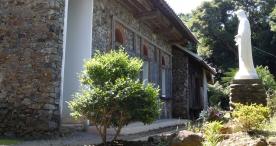
The Koteda family fled their home on the island of Ikitsuki and found refuge in the valley of Ono in 1599. Since it was too far from Shitsu, they set up their own church on a hillside overlooking the sea. Fr. de Rotz designed the church with distinctive stone walls called ‘dorokabe’ (translated either as ‘mud walls’ or ‘walls made by de Rotz’). The stone wall was piled up by the parishioners using the natural stones from the area. -
28
Endo Shusaku Literary Museum
The Endo Shusaku Literary Museum chronicles celebrated Japanese author Endo’s life and study and holds a collection of over 30,000 articles - largely Christian-related - including original written manuscripts and books relating to his writings. The most notable of which, Silence, has been translated to English and turned into an English-language film (Silence, 2016). This museum is located in Sotome that is a one hour drive away from Nagasaki City. It overlooks the Goto-nada Sea and is a picturesque spot for watching the sun set. The district was home to persecuted Christians during the ban on Christianity and is known as the hometown of Christians in Japan. While not originally from Nagasaki, Endo felt a strong bond with the district, calling it his second home. It was therefore the wish of his family that the museum be built in Sotome. The attached café, ‘Enchanté’, serves local food including Fr. De Rotz noodles. -
29

Nagasaki Hypocenter Park
At 11:02 am, August 9th, 1945: an atomic bomb detonated 500 meters above Matsuyama in Nagasaki City. Large numbers of people were killed immediately, while others died later from illness or injury - by the end of December, some 74,000 people had died while around 75,000 more suffered from injuries associated with the event. The area within a 2.5 kilometer radius of the hypocenter was utterly devastated, and the rest of the city was left in ruins. In 1968, a memorial monolith was built in the hypocenter park to mark ground zero of the atomic explosion. Beside the monolith, a part of the relics of the former Urakami Cathedral is preserved. A layer of the ground at that time is exhibited at the site, where visitors can see the remains of destroyed houses: roof tiles, bricks, ceramic and pieces of glass that boiled in the 3000℃ atomic heat. After the bombing, which destroyed all plant life around the hypocenter, people said that no plants would grow there for the next 70 years. However, one month after the atomic bombing, about 30 kinds of plants started to grow again. Today, there are bout 500 cherry blossom trees in the hypocenter park. The park is a favorite spot among local people for cherry blossom viewing in the spring time and as a green-filled oasis throughout the year. It truly captures the power of revival. Take a stroll around the many sites in the area: the Atomic Bomb Museum, the National Peace Memorial Hall for the Atomic Bomb Victims, the Peace Park, Urakami Cathedral with its atomic-bombed statue of the Virgin Mary, the Dr. Nagai Museum (a doctor and survivor of the atomic bombing), the local elementary school affected by the bombing with its own peace museum, the one-legged torii gate of Sanno Shrine and its surrounding camphor trees that survived the bombing. These are all located within walking distance. -
30
Gunkanjima Digital Museum
Gunkanjima, or Battleship Island are popular names for Hashima, the coal mining island that played a vital role in Japan’s Meiji Industrial Revolution. This digital museum uses cutting edge technology to recreate the island in its heyday. -
31

Glover Garden
This garden has been designated as an Important Cultural Asset. Here you can visit the beautiful traditional homes built for British merchants, including the oldest wooden Western-style home in Japan, built by the Scottish merchant Thomas Glover, who exerted a strong influence on the industrialization of Japan. The garden is lush with flowers, and has a stunning view of Nagasaki Port. The Christmas illuminations in winter time are also worth to visit. -
32
Site of the Martyrdom of the 26 Saints of Japan
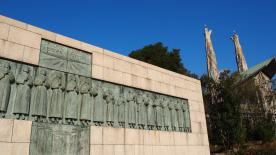
On February 5, 1597, twenty-six Catholics were executed here under the orders of Toyotomi Hideyoshi, marking the beginning of a two century long period of harsh Christian persecution in Japan. Today, this spot on Nishizaka Hill has been designated a Japanese National Sanctuary. Pope St. John Paul II visited this site on February 26, 1981 as a pilgrim for the martyrs. Background In the late 1500s, the government had begun to grow wary of foreign influence. To gain complete control over Kyushu, Toyotomi Hideyoshi issued an order to expel all priests from the country. The growing tension culminated in the arrest of six missionaries (including Spaniards, Mexicans, and Portuguese) and eighteen Japanese Christians in Kyoto and Osaka (some of whom had come from Nagasaki). They were forced to make the 800km walk to Nagasaki, chosen for its significant Christian population. They were joined by two more Catholics along the way. The journey took a month to complete, and when they finally made it to Nishizaka Hill, they were executed in front of the masses. Many more tragically followed. The martyrs were beatified in 1627, and canonized by the Pope in 1862. The Twenty-Six Martyrs Monument A monument dedicated to St. Paul Miki and his twenty-five companions was built at the site of the martyrdom in commemoration of the 100th anniversary of their canonization. This monument faces Oura Cathedral which is also dedicated to the martyrs. The Twenty-Six Martyrs Museum Behind the monument stands the Twenty-Six Martyrs Museum. At this museum, visitors can learn about the history of Christianity in Nagasaki - its rise, its prohibition, and its revival. A collection of items showcasing the lives of Christians as they hid from the authorities are on display here. These artifacts include the scroll Our Lady of the Snows (meticulously preserved by the faithful Hidden Christians in spite of the risk it posed), the "Maria Kannon" – a figurine shaped like the Buddhist Kannon used by Hidden Christians as the statue of Mary for worship, and personal belongings amongst others. There is also a collection of old maps and an original letter of St Francis Xavier's. A replica of the scroll of St. Mary of the Snows appears in the movie Silence (more information under Topics). Twenty-Six Martyrs Memorial St. Philip's Church (Nishizaka Church) Prominent for its uniquely designed twin towers that one may catch a glimpse of in the city area, this church, influenced by Gaudi and designed by Kenji Imai, is a church named after one of the martyrs. St. Paul Miki, St. Jacob Kisai, and St. John Goto's bones are stored here. This church is currently open for prayer and receives pilgrims from many nations every year. -
33
Dejima (Desima, Deshima) - Site of the Former Dutch Trading Post
Constructed in 1636, Dejima would later become a place where the Dutch East India Company would install a trading post, allowing the transport into Japan of both Western goods and the latest news of overseas current affairs. At the same time, Japanese goods, along with information about Japan, would be relayed to the West. During the long period of national seclusion (1641-1859), Dejima was the only door open to the outside world and gave Nagasaki the status of Japan’s sole international trading port. Dejima played an important role in the development of culture, industry, and science in Japan by serving as a gateway to the West. Many ambitious Japanese scholars traveled to Nagasaki to study Rangaku (“Dutch learning”, i.e., Western science) including medicine, chemistry, weaponry, navigation, and astronomy. The fan-shaped artificial island of Dejima no longer exists, lost to the repeated reclamation of the bay. Currently, Nagasaki City is engaging in plants to restore Dejima to its 19 century state. To carry out this restoration, foundation stones, stone walls and many other remains were excavated and some are exhibited inside the carefully reconstructed buildings. The buildings were constructed using traditional Edo period method and installed European furniture based on early 19th century drawings of the island and models of Dejima’s buildings that are preserved in the Netherland. Other exhibitions including the history of Dejima and Western learning and a miniature Dejima provide visitors with a sense of everyday life on Dejima. Furthermore, visitors can slip back in time to the era of the trading post by renting a Kimono. Usually it takes half an hour to put on a Kimono, but in this Kimono shop, you can dress up in the traditional Kimono in just 3 minutes. Dressing up in a Kimono and taking pictures against a backdrop of Japan-meets-West buildings is becoming a popular activity for visitors. -
 34
34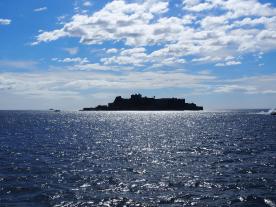
Hashima (Gunkanjima, Battle Ship Island)
Hashima is also known by its nickname “Gunkanjima” (Battleship Island) due to its unique silhouette. This island has been added to the List of UNESCO World Heritage Sites for its historical value based on its industrial heritage in 2015, as a component of "Sites of Japan’s Meiji Industrial Revolution: Iron and Steel, Shipbuilding and Coal Mining (Japan)." It has also been getting world-wide attention as it was the model for the “Dead City” in the James Bond movie “Skyfall” (2013). "Attack on Titan" (2015) was also filmed on this island. Gunkanjima flourished as a coal mining community since 1890. In 1974 when the coal mine closed, the island became completely deserted. Today, boat tours are offered to Hashima. -
35
Shianbashi & Doza
Experience Nagasaki’s night life at Shianbashi and Doza. Not only are the streets filled with delicious finds, it is also an area steeped in history, and relics from the past can still be spotted along the streets. -
36
Megane-bashi (Spectacles Bridge)
Megane Spectacles BridgeThe Nakashima River runs through a series of picturesque 17th-century stone bridges. Best-known is the double-arched Megane-bashi, or Spectacles Bridge, so called because the reflection of the arches in the water looks like a pair of eyeglasses. It was originally built in 1634, and was Japan’s oldest stone bridge. Unfortunately it was washed away by floodwaters in the 1982 disaster which killed 299 people, but was later restored using the recovered stones.Try spotting a heart-shaped stone near to the bridge and make a wish for eternal love.