

SEARCH RESULTS History Search Criteria: 93 Hits 1 - 12
-
 1
1Sotome Museum of History and Folklore
This museum features two floors of exhibits that showcase the rich and unique history of Sotome. From tools and machines used in olden Japan to artifacts collected from the Hidden Christian era, the Sotome Museum of History and Folklore is a record of the development of society, cultural exchange, and tragedy of the Christian persecution in Japan. English brochures are available for the first floor exhibits on tools and machinery and although none are for the second floor hidden Christian artifacts, it is worth a look for visitors interested in the Christian heritage of Nagasaki. You can listen to a recording of orasho (prayers by hidden Christians passed down through the generations) on the second floor. -
2
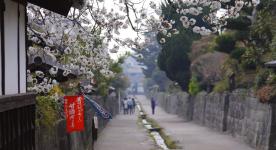
Old Samurai Warriors’ Houses
On the west side of Shimabara Castle, the samurai residences have been carefully preserved, complete with clear spring water flowing in canals down the center of the streets. -
3

Omura Sumitada Historical Park
Omura Sumitada was Japan’s first Christian Daimyo (Samurai war lord), who with foresight and vision sent a group of young Japanese emissaries to Rome (known as the “Tensho Embassy”).This park was built at the residence where Omura Sunitada breathed his last breath. A garden with a fountain and its clean flow of water still remains as the core attraction of the park. Visitors can learn some historical facts about Sumitada including details of local Japanese Christians and trading with the West. -
4
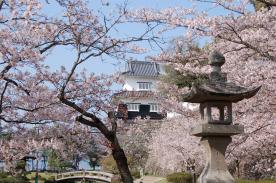
Omura Park
Omura Park was built over the outer moat of the former Kushima Castle. The park is filled with 300 blossoming cherry trees in spring and has been selected as one of “Japan’s Top 100 Cherry Blossom Spots”. Omura Sakura is said to be the most graceful cherry blossom with 60 to 100 petals per flower, while the ordinal cherry blossom has 5 petals. At the beginning of summer, some 300,000 irises bloom in the park. -
5
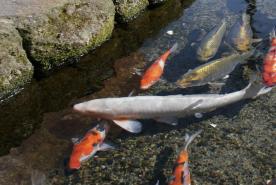
City of Swimming Carp
Shimabara has always been blessed with plentiful spring water. The “City of Swimming Carp” has been beautifully maintained by local people. The sight of the colorful nishikigoi carp swimming through the canals of the city is one of the most attractive features of Shimabara. -
6
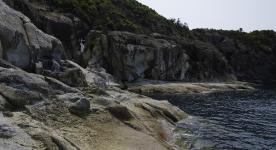
Christian’s Cave and the ‘Eye of the Needle’
It is said that during the repression of Christianity during the Meiji Era, believers lived in hiding in this cave. A 4-meter tall cross and a 3.6-meter statue of Jesus were built in 1967. Even now the cave is only accessible by boat. -
 7
7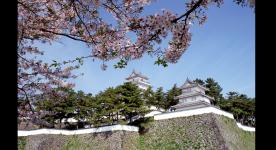
Shimabara Castle
At the castle, you can try on ninja and samurai armor and marvel at traditional crafts and documents of Christian and samurai history. It is also known as a perfect spot for taking pictures of a quintessential Japanese scene, the castle surrounded by flowers such as cherry blossoms and lotuses. -
8
Hirado Dutch Trading Post
The Hirado Dutch Trading Post was located here from 1609 to 1641, when Hirado was the main international trading port of Japan. It included many different buildings but the 1639 warehouse is said to have been the first full-fledged western style building in Japan. This building has been carefully reconstructed and houses a museum that tells the international trading history of Hirado.The most unique exhibits include a Dutch suit of armor which was rearranged in Japanese style by a Samurai. -
9
Kashiragashima Church
Kashiragashima ChurchThis sandstone church, a rare sight in Japan, was built by Christians returning to the islands after the period of persecution, from stones they quarried themselves. The church is designated as an Important Cultural Property of Japan and is part of the “Churches and Christian Sites in Nagasaki” bid for designation as a World Heritage Site. -
10
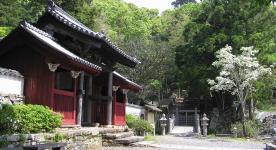
Banshoin
This Buddhist temple was built in 1615 by the Soh family, rulers of Tsushima Island during the Edo Period. This is the location of one of the three largest graveyards in Japan. -
11
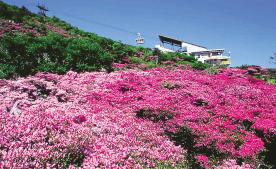
Nita Pass, Unzen
These mountains are famous for their azaleas in the spring, green colors in the summer, autumn leaves in the fall, and frosty fog in the winter. Enjoy the cable-car ride up to the top for breathtaking views. A brand new trekking path allows hikers to enjoy the mountain flowers and wild birds, as well as stunning close-up views of Heisei Shinzan, the peak newly-formed by the 1990s Fugendake eruption. -
12
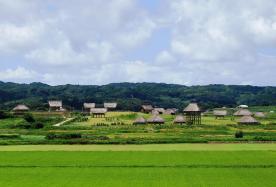
Haru-no-Tsuji Ruins
The archeological remains at Haru-no-Tsuji are located on a flat plain between Ishida Town and Ashibe Town. The area has provided important insights into life during the Yayoi Period (approx 300BC - 300AD) and has been designated as a site of National Historical Interest. The moated settlement is regarded as the location of the ancient capital of Iki, a country that existed in that period. It appears in a Chinese historical text “The Records of the Three Kingdoms”, as the oldest kingdom in Japan. 17 buildings have been restored at the site.