
SEARCH RESULTS History Search Criteria: 105 Hits 37 - 48
GoogleMap Loading...
-
 37
37
Egami Church
Facing the Naru Strait, Egami Church stands on the coast surrounded by a grove of trees. In 1918, the descendants of settlers cooperated to build the church, under the design and surveillance of Tetsukawa Yosuke. Thanks to funds raised by that year’s abundant fish haul, the construction reached a level of perfection rarely seen among wooden churches in Japan. -
38
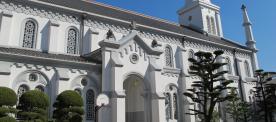
Nakamachi Church
Dedicated to the 16 Martyrs of Nagasaki, this church is located close to JR Nagasaki Station, and the 26 Martyrs site on Nishizaki Hill. The first Nakamachi Church was built in 1896 using funds donated by an anonymous French person, to commemorate the 330th anniversary of the deaths of the 26 Martyrs and as dedication to the Blessed Virgin Mary. The church was destroyed by the atomic bomb in 1945, but was rebuilt by parishioners in 1951. In 1988, a monuments to the16 Martyrs was constructed in a garden at this church. Cardinal Jaime Sin of Manila attended the unveiling ceremony for the monument, in recognition of Lorenzo Ruiz, the first Filipino saint. In 2015, the little Japanese garden and the monuments to the 16 saints were refurbished to commemorate the 150th anniversary of the “Discovery of the Christians”. -
39
Site of Martyrdom at Arima
Arima Naozumi, the 15th ruler of the domain, recanted his belief in Christianity and initiated the persecution of the Christians. In 1613, on the spacious beach in front of Hinoe Castle, he executed his Christian vassals and their families who had refused to recant. More than 20,000 Christians gathered and watched as the condemned were burned alive. Despite Naozumi’s intention to set an example, the local Christians consolidated their religious belief, spurring the Shogunate to issue the Anti-Christian Edicts the following year. In 2007, the executed Christians were beatified and added to the list of 188 Blessed Japanese Martyrs. -
40
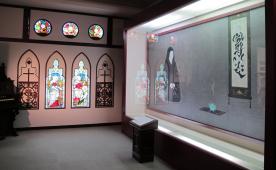
Shima no Yakata: Museum of Ikitsuki
The museum presents information on the history and folklore of the island of Ikitsuki. The large exhibition hall is designed like the inside of a church and displays artifacts related to livelihood and religion. The hidden Christians maintained their faith even under severe oppression, in a unique form mixing Christianity with Buddhism and Shintoism. Fisheries and agriculture thrived in the rich natural environment. The traditional equipment, miniature models and dioramic images inform visitors about the colorful history of Ikitsuki Island. -
41
Site of the Martyrdom at Kurose: Grave of Nishi Gaspar
Nishi Gaspar held a leading position related to the administration of the village. In 1606, he was executed at Kurose-no-Tsuji as the last martyr on the island of Ikitsuki. The execution ground was called Kurose on the basis of the Spanish word cruz (cross). The site is now a park where a large new crucifix has been erected. The grave of Nishi Gaspar and his family is just behind this monument. His son, Tomas Nishi, who was the only survivor, later became a priest in Manila in the Philippines, but was ultimately martyred at Nishizaka in Nagasaki City. -
42
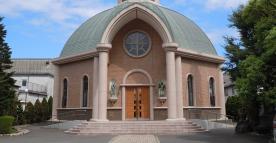
Shimabara Church
In 1932, Shimabara Ninomaru Church was established and dedicated to the martyrs in the Shimabara Rebellion. The church was reconstructed into the present domed building in 1997. -
43
Unzen Church
Constructed to celebrate Pope John Paul II’s visit to Japan in 1981, the church was consecrated to the Jesuit Antonio Ishida of Shimabara (one of the 205 Blessed Japanese Martyrs beatified in 1632), and to the victims tortured to death at the Unzen Hells. -
44
Memorials to Saint Kolbe Hongochi Church・St. Kolbe Memorial Museum・Lourdes in Hongochi
Maximilian Maria Kolbe OFM arrived in Nagasaki from Poland in 1930 and established the monastic order Ordo Fratrum Minorum Conventualium at the foot of Mt. Hiko. He propagated the “Innocent Heart of the Virgin Mary” through its publication Seibo no Kishi (the Knights of the Immaculata). He also met Dr.Nagai in Nagasaki, who gave him a medical examination. St. Kolbe died at Auschwitz. In 1982, Pope Paul II canonized him and also applauded his colleague Friar Zenon for his vigorous missionary activities. Right above the museum, in the neighborhood of Hongochi Monastery, Kolbe found a cave resembling the sacred one at Lourdes in France. Pope John Paul II visited this spot during his tour of Japan in 1981. In 1984, the Vatican officially added the Hongochi Lourdes to its list of pilgrimage sites. -
45
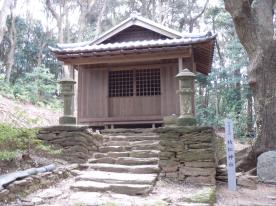
Karematsu Shrine
Karematsu Shrine is dedicated to Jiwan, Bastian’s religious leader. He passed away from hunger and cold while hiding in a valley and observing religious practices. The local people buried him and worshipped his tomb as a sacred place. Each November, locals hold the Karematsu Shrine Festival, when ecumenical prayer services are held as well as a mass conducted by a Catholic priest. This is one of only three shrines in Japan dedicated to holy figures associated with Christianity. -
46
Christians’ Cave at Wakamatsu Island
To evade the persecution of the Goto Kuzure, Christians hid themselves in a 50m-deep cave only accessible by boat. They were discovered when a passing boat saw smoke from their cooking fire, arrested and tortured. Later, this place came to be known as Christians’ Cave, and a 3m statue of Christ was erected at the cave entrance in 1967. Around All Souls’ Day (November 2), the Christians of the nearby parish hold a memorial service here and console the spirits of the ancestors by cooking a meal. Even now, this holy site can only be visited by boat. -
47
Memorial Church and Monument to Martyrdom at the Site of Royanosako Jail
In 1868, more than 200 Christians were imprisoned here in a space of less than 20m2. Crammed into this space, they were ordered to recant their beliefs. 39 prisoners including women and children lost their lives during the eight months of imprisonment. The jail was called Royanosako (the jail pit). On the site, there is a monument engraved with the names of the martyrs. -
48
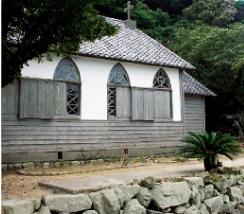
Former Gorin Church
The Former Gorin Church building has an interesting history. Hamawaki Church, built in 1881, was the second oldest wooden church in Nagasaki Prefecture, after Oura Cathedral. In 1931, a new, larger church was to be built at Hamawaki, and the old church was dismantled and then reconstructed as a church for the Gorin district. The church, which has been designated as an Important Cultural Property of Japan, is a rare combination of Japanese- and Western-style construction, with the outer appearance of a traditional Japanese house.