
SEARCH RESULTS History Search Criteria: 105 Hits 13 - 24
GoogleMap Loading...
-
 13
13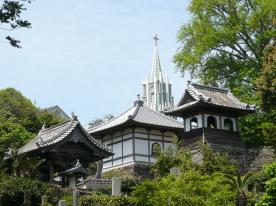
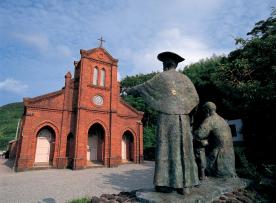
St. Francis Xavier Memorial Church, a view of a Christian Church and Japanese Temples
Constructed in 1913 as the Hirado Catholic Church, it was relocated to its present site in 1931. The statue of St. Francis was erected in 1971 to to honour the missionary’s visit to Hirado in 1550, and the church later given its present name. An exotic view of a Japanese temples with this church from a street down to the town was described by the Lonly Planet as "one of the most photogenic vantage points in all of Khushu." -
14
Nagasaki Shinchi Chinatown
Nagasaki Chinatown, located in Nagasaki City is one of the three largest Chinatowns in Japan, alongside those in Yokohama and Kobe. This area is now a popular sightseeing spot for original Nagasaki-style Chinese food and the Nagasaki Lantern Festival, the largest Chinese New Year celebration in Japan. During the national isolation period, Nagasaki Port was opened as an exception for trade with China from 1635. Chinese could reside around Nagasaki City until 1689 when the feudal lord decided to restrict them to a specific ‘Chinatown’ in order to combat commercial fraud. No Japanese citizens were allowed to enter the Chinatown area except geisha and monks, although Chinese people were able to leave to visit the Chinese temples in Nagasaki City, thus transporting Chinese culture to the local Nagasaki people. Trade goods included silk, sugar, medicines and books. Moreover, Chinese culture had a great influence on the people of Nagasaki. Since then, Nagasaki has enjoyed famous Chinese-influenced events year-round, including ‘Shourou Nagashi’ (the Spirit Boat Procession), the Nagasaki Peiron (dragon boat) Championship and the Dragon Dance performed at various festivals. After 1859, with the opening of Japan to foreign countries, the Chinese residents in Nagasaki transferred to Shinchi Town where the current Chinatown is located. Along the 250m of streets meeting at a crossroads, there are about 40 restaurants serving Champon and Saraudon, the famous Nagasaki Chinese cuisine, as well as souvenir shops. This area is popular for tourists especially when decorated with thousands of lanterns during the Lantern Festival. -
15
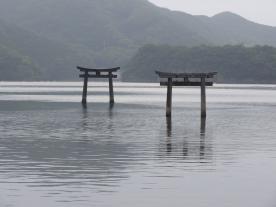
Watazumi Shrine
A mysterious sea shrine with five torii gates which extend in a line from the ocean. Two of the torii are in the sea, changing their appearance with the ebb and flow of the tide, recalling the legendary tales of the Dragon Kingdom. If you rent a kayak at the Shinwa-no-Sato Nature Park, you can sea-kayak toward the shrine. -
16
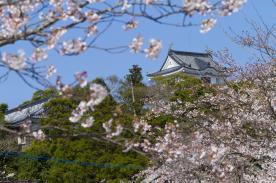
Hirado Castle
Hirado Castle offers a commanding view of Hirado Port and the ancient forest of Kurokojima Island. Its museum contains many valuable relics dating back to the Hirado’s feudal past. -
17
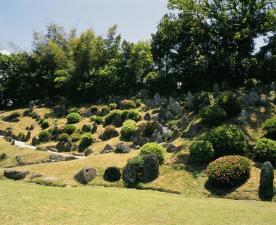
Stone Garden of the Former Enyu-ji Temple
Enyu-ji Temple was built by the fourth domain chief Suminaga in 1652. Designed in the “stone garden” style of the early days of the Edo period, the garden uses a variety of stone combinations with over 400 stones along a slope stretching some 50 meter east-west. Reminiscent of the original grandeur of the garden, it also features a gardening concept that simulates a san-sui (mountain-water) landscape painting with water flows simulated by white pebble stones, and dry falls and flows created using the natural topography. -
18
Dozaki Church
This is the oldest church in the Goto islands, and it was built by French missionaries. It now serves a museum displaying historical documents relating to Christians and the 300-year period of suppression of Christianity. It was designated as a Tangible Cultural Asset of Nagasaki Prefecture in 1974. -
19
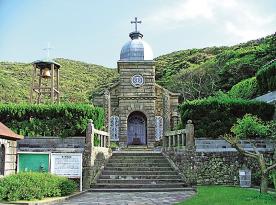
Kashiragashima Church
Kashiragashima ChurchThis sandstone church, a rare sight in Japan, was built by Christians returning to the islands after the period of persecution, from stones they quarried themselves. The church is designated as an Important Cultural Property of Japan and is part of the “Churches and Christian Sites in Nagasaki” bid for designation as a World Heritage Site. -
20
Old Samurai Warriors’ Houses
On the west side of Shimabara Castle, the samurai residences have been carefully preserved, complete with clear spring water flowing in canals down the center of the streets. -
21
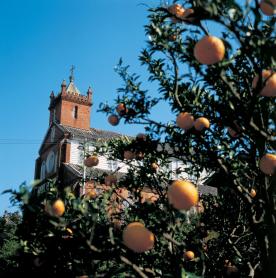
Kuroshima Church
Kuroshima Island is the largest of the Kujukushima islands. Two months after the discovery of the hidden Christians in Oura Cathedral in 1865, 20 representatives of the hidden Christians visited Father Petitjean in Oura to confess their faith. Subsequently, Father Poirier read the first mass in Kuroshima Island at the house of Daikichi Deguchi, one of the representatives. By 1873, Kuroshima had become an "island of Catholic." Kuroshima Church was constructed through the endeavors of Father Marman, with the self-sacrificing cooperation of the local laypeople. They carried bricks and other necessary materials by themselves, climbing up the steep slope from the beach.The interior of this church is magnificent, with arcades, triforia and clerestory. Kuroshima Church is unique in that Arita porcelain tiles, granite quarried in Kuroshima and other local materials are used. -
22
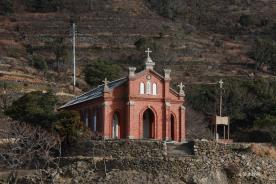
Former Nokubi Church
In the Nozaki Island, located in the north of the Goto Islands, there used to be two Christian communities, called "Nokubi" and "Setozaki." In spite of the poverty due to the mountainous area and infertile soil, both communities built wooden churches. Eventually, 18 Christian families began constructing a brick church. Through their endeavors and enthusiasm, Nokubi Church was completed. It was designed and constructed by Yosuke Tetsukawa, and it was the first brick church for him. However, after Japan entered the period of rapid economic growth, more and more people left the island. By 1971, all the residents had gone out of Nozaki Island. On the now uninhabited island, Nokubi Church soon deteriorated. However, the church was restored and repaired by the government of Ojika Town, in which the church is located. -
23
The Nagasaki Atomic Bomb Museum
The Nagasaki Atomic Bomb Museum covers the history of this event in the accessible form of a story. It begins with the disastrous scene of the attack and includes the events leading up to the dropping of the atomic bomb, the reconstruction of Nagasaki up to the present day, the history of nuclear weapons development, and the hope for a peaceful world free of nuclear weapons. -
24

Unzen Hot Spring & Unzen Jigoku (“Unzen Hell”), the Site of Martyrdom at Unzen
Unzen Hot Spring: One and half-hour’s drive from Nagasaki City will take you to Unzen. As it was the country’s first resort targeted at foreign guests, you can also find Western- and Japanese-style hotels here. Now it is one of Japan’s most famous hot spring resorts. Unzen Jigoku (“Unzen Hell”): Hot water and gases spout out of the earth. White steam and a smell of sulfur accompany you as you walk through this hotspot of volcanic activity. The songs of the wild birds bring another aspect to the scene: in this place, nature shows both its fierceness and beauty in a fascinating spectacle. It was also a site where Christians were martyred. A document records that Matsukura Shigemasa, posted to the Shimabara domain, tortured Christians at so-called ‘hells’ in the mountains of Unzen. During the period between 1627 and 1632, Christians were tortured to death in the boiling waters of the hot springs. At a place called Oito Jigoku (‘Oito Hell’) stand two monuments to the victims, although the exact sites of the martyrdom are uncertain.